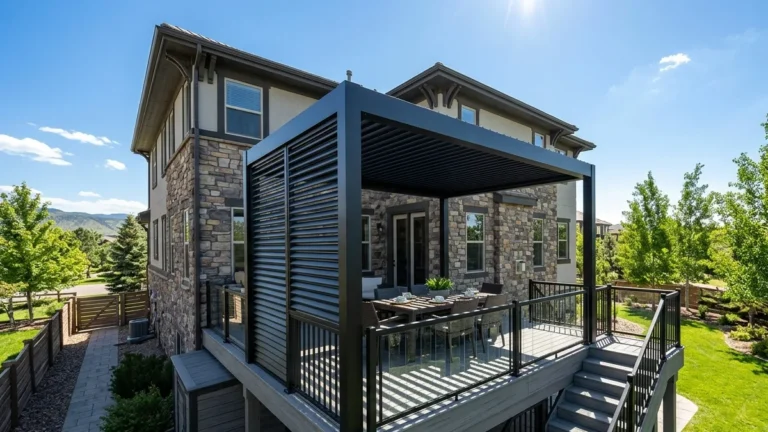
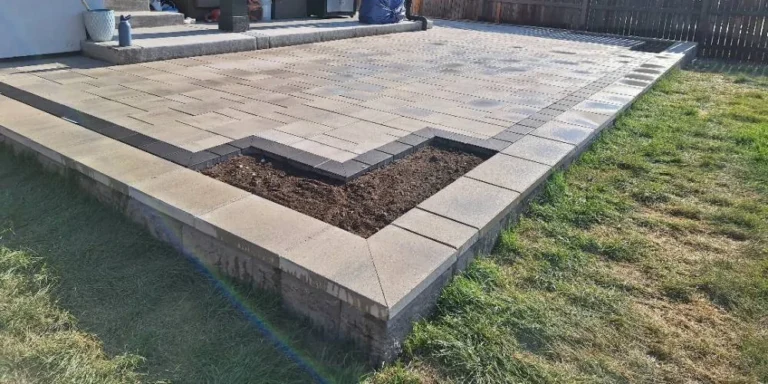
Pavers vs stamped concrete is the question we hear most from homeowners planning a new patio in Highlands Ranch, Littleton and the rest of the south Denver metro. Lately a third option has joined the conversation: resin-bound stone, a smooth, seamless surface that drains straight through. All three can look great on day one. The difference shows up after a few Colorado winters.
We install pavers and resin-bound stone, and we are often called out to stamped concrete that has cracked or faded, so we see how all three age. This guide explains how each surface is built, how it handles clay soil, freeze-thaw and snow, what upkeep really looks like, and the five differences that decide which one fits your yard.
The Short Answer
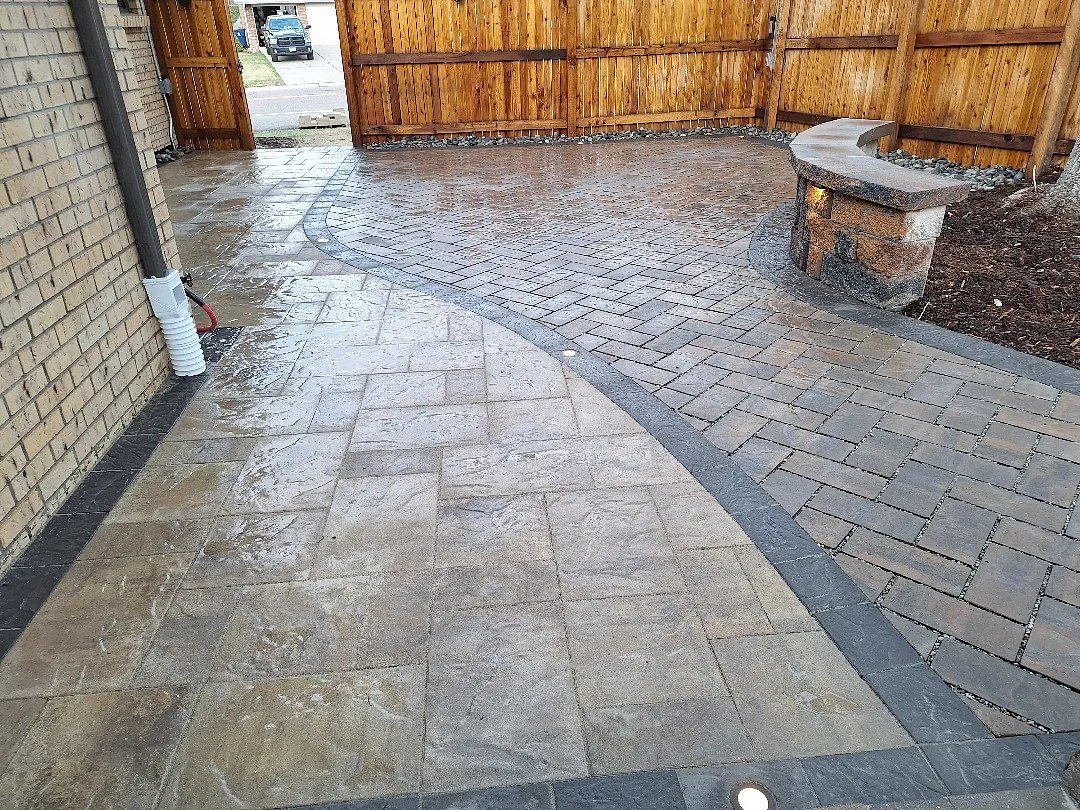
Pavers are the most forgiving on clay soil and the easiest to repair, because each unit can be lifted and reset. Stamped concrete gives you the look of stone or brick in one continuous slab, but it relies completely on its base and joints, and it needs resealing to keep its color. Resin-bound stone drains water through its surface, has no joints at all and needs almost no upkeep, but it has to go over a sound, well-built base and needs dry weather to install.
None of them is the best in every yard. The right one depends on your soil, how water moves across your lot, how you use the space and how much upkeep you want.
Pavers vs Stamped Concrete vs Resin-Bound at a Glance
| Feature | Pavers | Stamped concrete | Resin-bound stone |
|---|---|---|---|
| What it is | Individual concrete or stone units on a compacted base, locked together with sand in the joints | One poured slab, colored and pressed with a pattern while it is still wet | Natural stone mixed with clear resin and troweled into one seamless surface |
| On clay soil | Flexes with small movement, and lifted areas can be reset | Rigid, so movement shows up as cracks | Follows the base underneath, so the base has to be stable |
| Water | Runs off the surface, or drains through if built as permeable pavers | Runs off the surface | Drains through the surface into the base below |
| Repairs | Lift, fix the base, set the same pavers back | Patch or replace sections, which rarely matches perfectly | Small areas can be patched, but the base has to be right first |
| Upkeep | Top up joint sand now and then, optional sealing | Reseal every 2 to 3 years, keep deicing salt off | Sweep and rinse, no sealing schedule |
| Look | Huge range of shapes, colors and patterns | Stone, slate, brick or wood textures in one slab | Smooth natural stone finish with no joints |
| Best for | Patios, pool decks, walkways, driveways on active clay | Larger simple patios where a seamless look matters | Paths, pool surrounds, patios and resurfacing sound concrete |
How Each One Is Built
In the pavers vs stamped concrete debate, most people compare the surfaces. But what you walk on is only the top inch or two. What decides how long a patio lasts is underneath it, and each surface is built differently.
Pavers
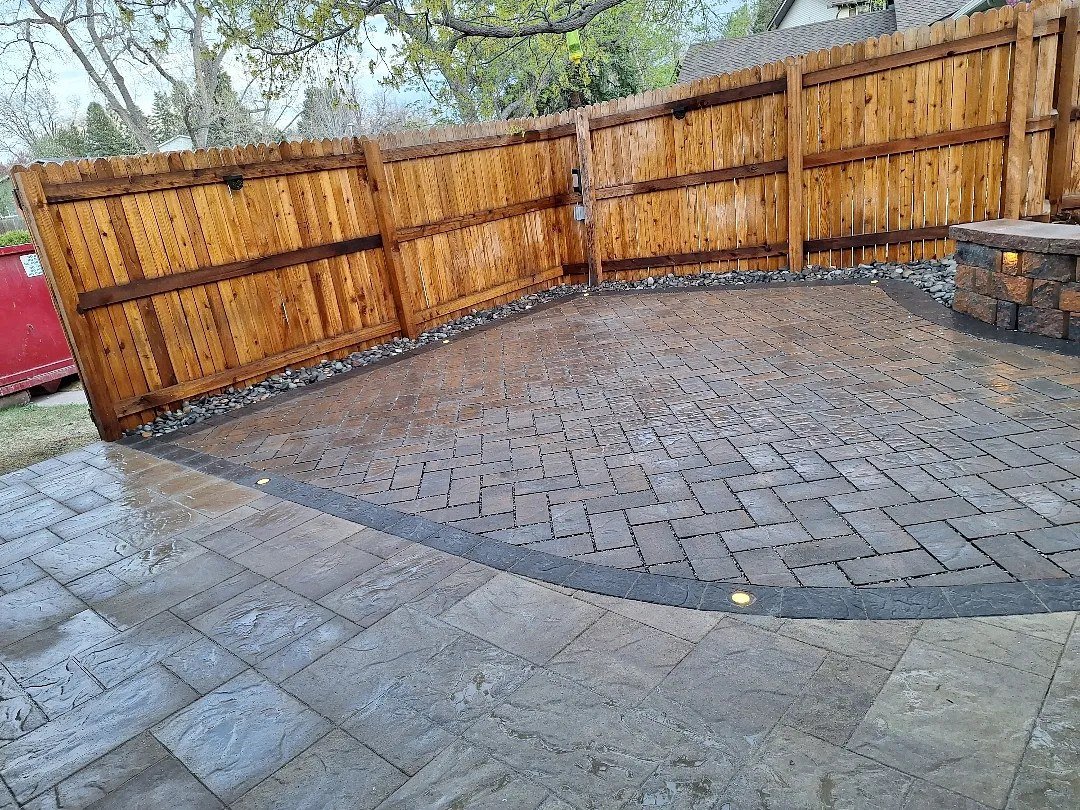
For a paver patio we dig out the soft clay, build up a gravel base in thin layers and compact each one, then screed a bedding layer and set the pavers. Edge restraints hold the outside row in place, and sand swept into the joints locks everything together. Good concrete pavers are made to a published standard, ASTM C936, which calls for an average compressive strength of at least 8,000 psi and low water absorption. That density is a big part of why pavers stand up to freeze-thaw and deicing salt.
Stamped Concrete
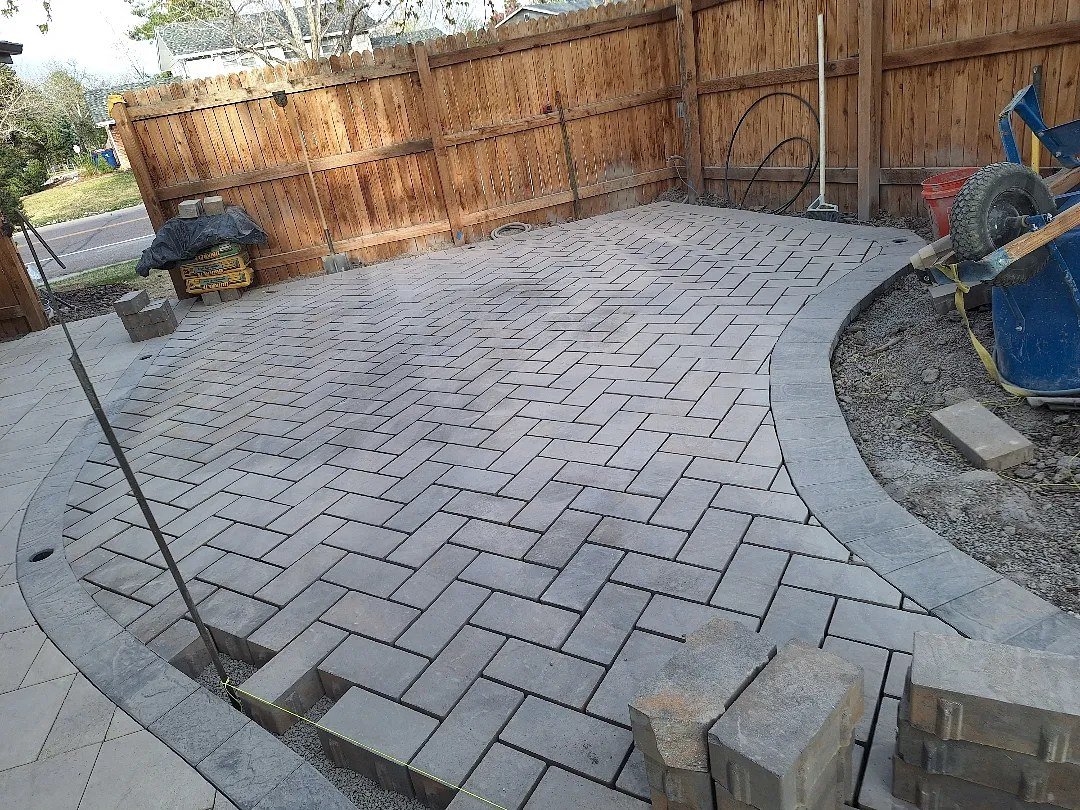
Stamped concrete starts the same way, with a compacted gravel base and the right slope away from the house. Then a reinforced slab is poured, colored and pressed with textured mats before it sets. Control joints are cut at planned spacing so the slab cracks along those lines instead of across the pattern. Our guide to concrete patios in Highlands Ranch goes into the base, joints and finishes in more detail.
Resin-Bound Stone
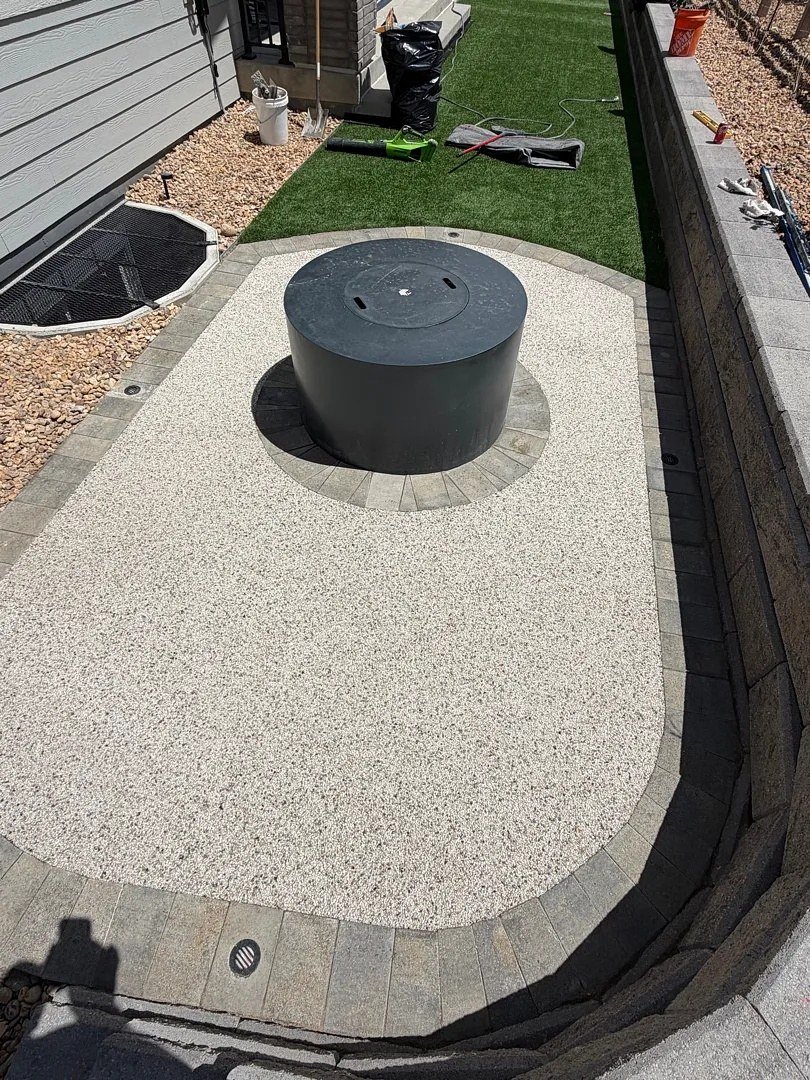
Resin-bound stone is mixed on site. Natural aggregate is coated in a clear, UV-stable resin and troweled out by hand over a permeable base, or over existing concrete or asphalt that is still sound. Every stone is bonded to the ones around it, so there is nothing loose and no joints. As a Vuba Approved Installer, we follow the manufacturer’s system for the base and the mix. Our resin-bound stone guide explains where it works best.
5 Differences That Matter in Colorado
1. How they handle clay soil
Most of Douglas County sits on expansive clay that swells when it gets wet and shrinks as it dries. A concrete slab is one rigid piece, so when the clay pushes up under part of it, it cracks. Pavers are separate units on a flexible base, so they can shift slightly without breaking, and if a corner does lift, that section can be taken up, the base fixed and the same pavers relaid. Resin-bound stone has a little flex in the binder, but it follows whatever is underneath, so on active clay the base matters even more. Our guide to expansive clay soil explains what that movement does to hardscape.
2. Freeze-thaw, snow and ice
The Front Range goes through dozens of freeze-thaw cycles every winter. Water that gets into a surface and freezes expands, and over time that flakes the top layer off weaker concrete. Dense pavers resist it well. Stamped concrete holds up when it is air-entrained and kept sealed, but deicing salt is hard on it, and the sealer tends to fail first where salt or drips from cars land. Resin-bound stone lets meltwater drain through instead of sitting on top, which means fewer icy patches. For all three, use a plastic shovel or blade and go easy on rock salt.
3. Drainage
Pavers and stamped concrete both shed water across the surface, so the slope has to carry it away from the house and the yard has to have somewhere to send it. Pavers can also be built as permeable pavers with open joints and a stone base that soaks water in. Resin-bound stone is permeable by design when it sits on a permeable base, which makes it a strong choice for low spots, paths and pool surrounds where water likes to pool. If your yard already holds water, it is worth reading the signs you need a French drain before choosing any surface.
4. Repairs down the road
This is where pavers stand out. A sunken area, a stained paver or a trench for a new gas line or sprinkler pipe can be opened up and closed again with the same pavers. Stamped concrete can be patched, but matching the color and pattern on a repair is hard, and a crack across the pattern is always visible. Resin-bound stone can be patched in small areas, but the edges of a patch can show, which is why it is so important to get the base right the first time.
5. Upkeep and how they age
Pavers need the joint sand topped up every so often, and sealing is optional but helps hold color and keep weeds out. Stamped concrete needs resealing every 2 to 3 years to protect the color and the surface, and our strong Colorado sun fades unsealed color faster than most people expect. Resin-bound stone needs the least, an occasional sweep and rinse, with no sealing schedule and no joints for weeds.
What Drives the Cost of Each
Pavers vs stamped concrete vs resin-bound is not only a question of upfront cost. We do not publish prices, because no two yards are the same and a number online is rarely the number you end up paying. What we can tell you is what moves the cost, so you can compare quotes properly.
| What changes the cost | Why it matters |
|---|---|
| The base | On clay, a deeper, properly compacted base is the biggest single factor in how long any patio lasts, and the most common thing a cheap quote leaves out. |
| Size and shape | Curves, steps, levels and lots of cuts take more labor than a simple rectangle, for all three surfaces. |
| The surface you choose | Paver style and pattern, stamp pattern and color, and the aggregate blend for resin-bound all change the material cost. |
| Removing what is there | Breaking out an old slab adds demolition and hauling. Resin-bound can sometimes go over sound concrete instead, which avoids that step. |
| Drainage | Regrading, drain pipe or a permeable build add work but protect everything above them. |
| Access | If equipment or a concrete truck cannot get close, materials have to be moved in by hand or pumped. |
| Long-term upkeep | Resealing stamped concrete every few years is a cost too, so compare what each surface costs over ten years, not just on day one. |
When you compare quotes, ask each contractor how deep the base will be, how it will be compacted, and where the water will go. If two quotes are far apart, the difference is usually below the surface.
Which One Fits Your Yard?
Choose pavers if your yard is on active clay, you want a pool deck or a driveway that can be repaired without tearing it out, or you like the idea of patterns, borders and mixed colors. They are also the safer choice where utility lines run under the patio.
Choose stamped concrete if you want one continuous surface with the texture of stone or brick, the area is fairly simple and the ground is stable, and you are happy to reseal every few years.
Choose resin-bound stone if water pooling and ice are your main worries, you want the lowest upkeep, or you have sound concrete that looks tired and would rather resurface it than replace it. It also suits pool surrounds, since it stays grippy when wet.
Pavers vs stamped concrete does not have to be either-or, and many of our projects mix them. A paver patio with a resin-bound path, or a paver pool deck next to a resurfaced pool deck, can give you the strengths of each where they matter most. If you are still deciding between a raised deck and a ground-level surface, our deck vs patio guide covers that choice.
Pavers vs Stamped Concrete FAQ
Do pavers last longer than stamped concrete?
On clay soil, a well-built paver patio usually ages better, because small movement does not crack it and damaged areas can be reset. A stamped slab on a good base with proper joints and regular sealing can also last for decades. In both cases, the base matters more than the surface.
Does stamped concrete crack in Colorado?
All concrete cracks to some degree. Control joints are there so it cracks in a straight line where you expect it. Cracks across the pattern usually trace back to a thin base, missing joints or water getting under the slab.
Can resin-bound stone go over my old patio?
Often, yes, if the existing concrete is solid and not heaving or badly cracked. We check it during the onsite visit. If the slab is failing, it has to be dealt with first.
Which surface is best around a pool?
Pavers and resin-bound stone are both strong choices. Pavers can be lifted to reach plumbing and are easy to repair. Resin-bound drains quickly and stays grippy when wet. Stamped concrete works too, but it needs a slip-resistant sealer and regular resealing.
When should I plan a spring patio?
Winter. The onsite visit, design and any HOA approval can all be done before the ground thaws, so your project is ready to start when spring opens up. Our guide to HOA approval in Highlands Ranch explains the timing.
Get the Right Surface for Your Yard
Pavers vs stamped concrete vs resin-bound stone does not have a single winner. All three can last in Colorado when they are built on the right base with somewhere for the water to go. The best way to choose is to look at your soil, your slope and how you want to use the space, in person.
Call Elevate Landscape & Spas at (303) 718-4619 to book a free onsite visit and get a quote, or contact us online.
Rather We Call You?
Leave your name and number and we’ll call you back — usually the same day. Or call us now on (303) 718-4619.
Rather write it down?
✎ Send us your project details