Wondering about retaining wall cost in the Denver area? If your yard slopes, washes out after every storm, or has a bank you can’t use, a retaining wall is usually the fix. The first question is always the same: what will it cost?
The honest answer is that it depends on four things: the material, the height, what’s behind the wall, and whether it needs a permit. Here’s how each one moves the price in the Denver area, using published market ranges, so you know what a fair quote looks like before anyone comes out.
Typical retaining wall cost in Denver by material
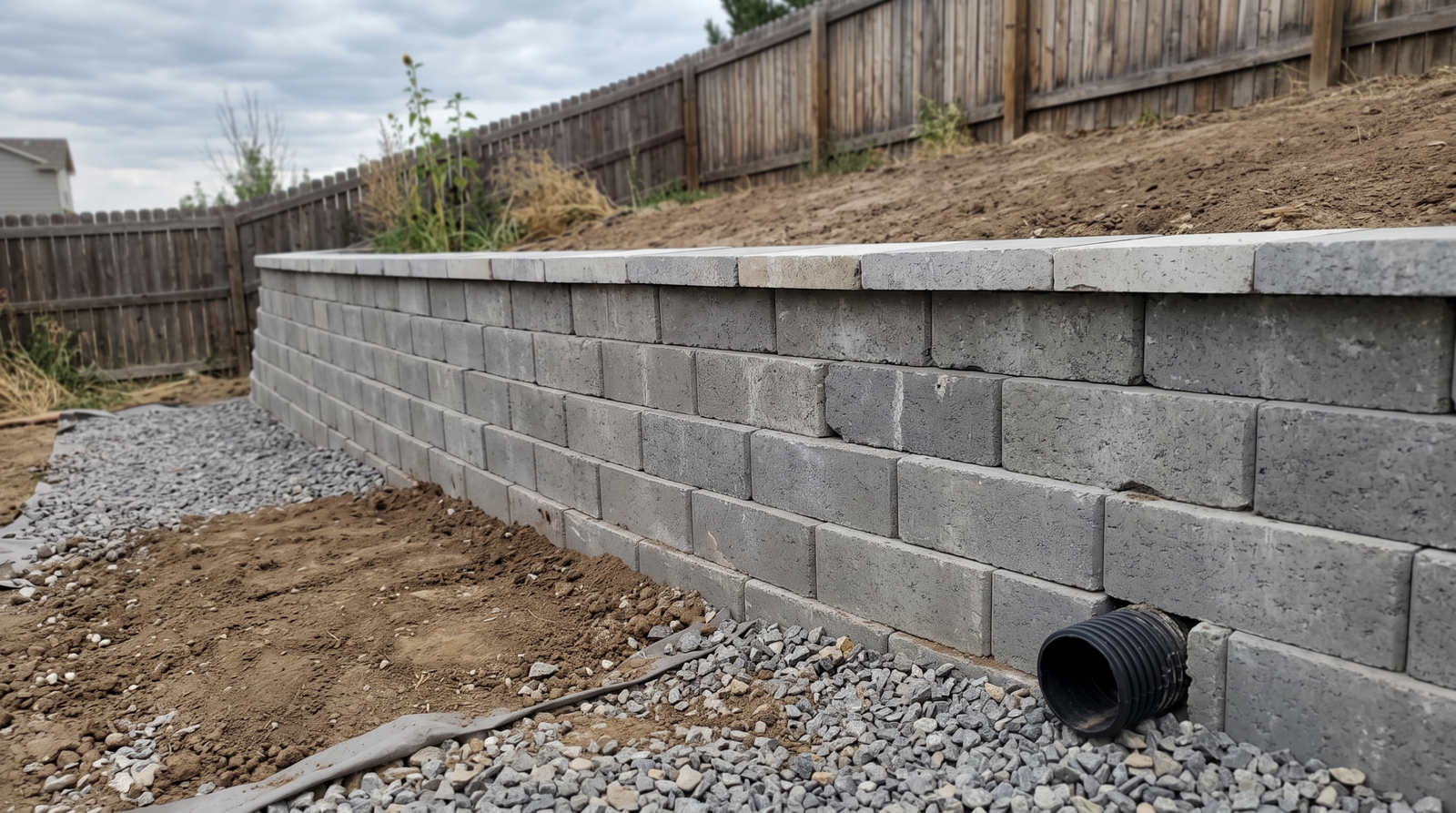
Segmental block (interlocking concrete block). The most common choice for residential walls. Brands like Allan Block and Belgard stack without mortar, drain well, and handle freeze-thaw. For a typical 50 ft long, 3 ft high wall, published Denver ranges run roughly $3,750 to $7,500.
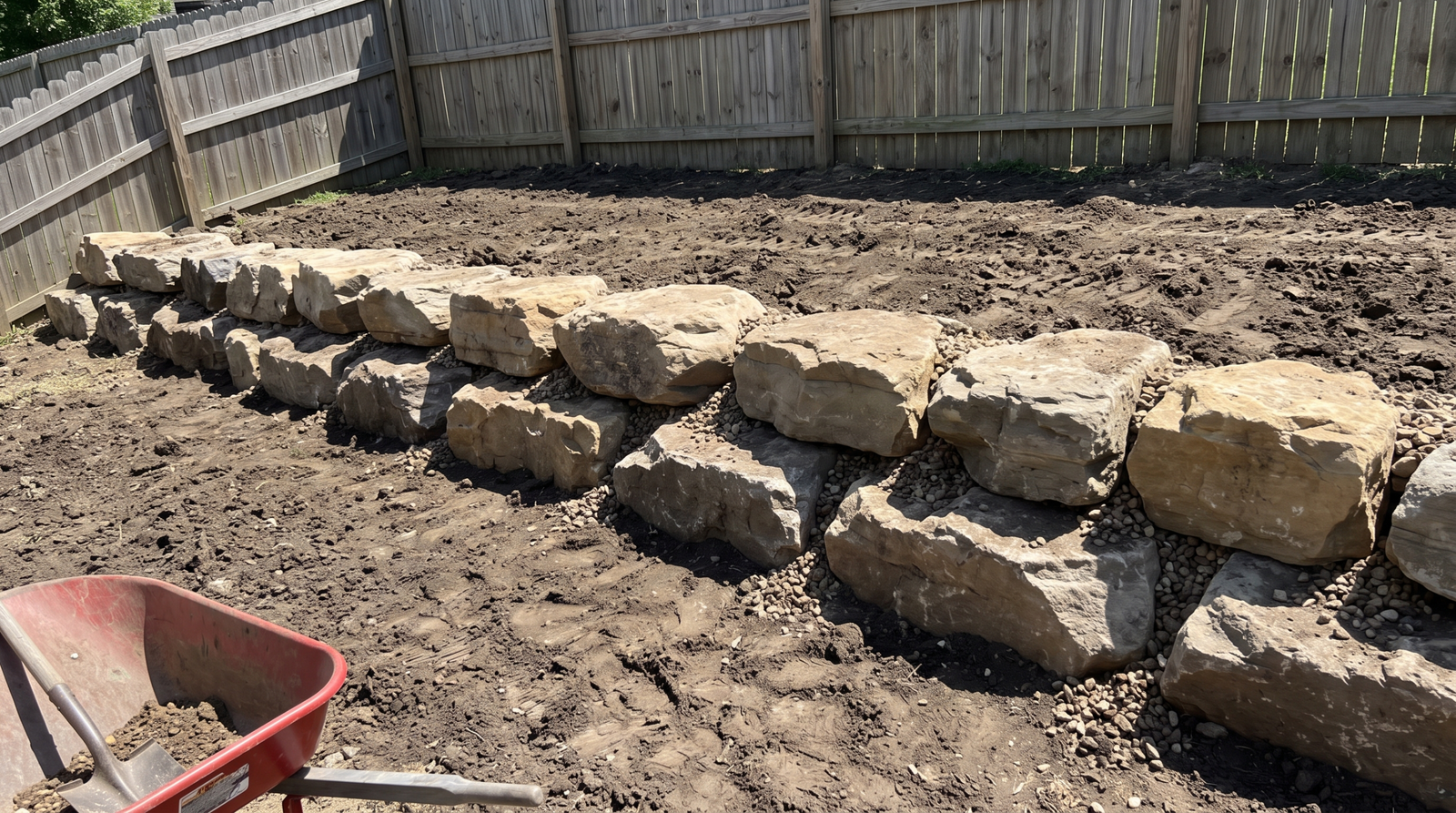
Natural stone and boulder walls. More natural looking and very durable, but heavier and slower to build. The same 50 ft by 3 ft wall in natural stone typically runs $7,500 to $15,000. Large boulder walls vary widely with stone size and how far it has to travel.
Poured concrete. Very strong and long-lasting, and it can be colored or stamped to look like stone. It needs forms, reinforcement and curing time, so it usually sits in the middle to upper part of the range.
Wood. The lowest upfront cost, but in Colorado’s freeze-thaw cycles it usually has the shortest life, so it’s rarely the cheapest over 15 to 20 years.
The average retaining wall cost for a Denver-area home lands around $5,500, but your wall could be well above or below that depending on the next few factors.
How to estimate your retaining wall cost
Contractors usually work out retaining wall cost from the face area, the part you see. To get a rough number for your own yard, multiply the length of the wall by its height, then multiply that by a price range for your material.
Here’s an example. A wall 40 feet long and 3 feet high has a face of 120 square feet. The published Denver ranges above work out to roughly $25 to $50 per square foot for segmental block and $50 to $100 per square foot for natural stone. So the retaining wall cost for that 120 square foot wall would land somewhere around $3,000 to $6,000 in block, or $6,000 to $12,000 in natural stone.
Treat this as a starting point, not a quote. Drainage, soil, access and permits, all covered below, can move the final number either way.
Retaining wall cost by height
Using the same block range, here’s roughly how retaining wall cost changes as a 50 foot wall gets taller:
| Wall height | Face area | Rough block wall cost | Permit and engineering |
|---|---|---|---|
| 2 ft | 100 sq ft | $2,500 to $5,000 | Usually not needed |
| 3 ft | 150 sq ft | $3,750 to $7,500 | Usually not needed |
| 4 ft | 200 sq ft | $5,000 to $10,000 | Often at the threshold, check your city |
| 5 ft and up | 250+ sq ft | $6,250 to $12,500+ | Usually required, add $700 to $2,500 |
Taller walls often raise the retaining wall cost per square foot too, because they need a deeper base, more drainage and geogrid reinforcement. That’s why the jump from 4 feet to 5 feet is bigger than the jump from 2 feet to 3 feet.
What pushes retaining wall cost up
Height. Height affects retaining wall cost more than length does. A wall that holds back 4 feet of soil is doing far more work than one holding 2 feet, so it needs a deeper base, more reinforcement and more backfill. Many quotes jump noticeably once a wall passes about 3 to 4 feet.
Engineering and permits. In most Denver-area cities, walls over 4 feet, or walls holding up a driveway, slope or structure above them, need a permit and stamped engineering. Budget roughly $500 to $2,000 for engineering and $200 to $500 for the permit, and allow a few weeks for approval. Rules vary by city, so this gets checked before any quote is final.
Drainage. This is where cheap walls fail. Water trapped behind a wall builds pressure every storm and every spring thaw. A proper wall has a gravel drainage zone and a perforated drain pipe behind it. It adds cost, but it’s the difference between a wall that lasts decades and one that leans in three years.
Clay soil. Much of Douglas and Arapahoe County sits on expansive clay that swells when wet and shrinks when dry. Walls here need a solid compacted base and good drainage, and taller walls may need geogrid (a reinforcing mesh laid into the backfill) to stay put.
Access. If a skid steer can’t reach the wall, blocks, stone and gravel are moved by hand, and labor goes up.
HOA approval. Many Highlands Ranch neighborhoods need HOA sign-off for visible walls. It rarely changes the price, but it can change the timeline, so start early.
How to compare quotes fairly
When you compare retaining wall cost quotes, check that each one includes:
- The wall material and brand
- Base depth and base material
- Drainage gravel and drain pipe behind the wall
- Geogrid, if the wall is tall enough to need it
- Excavation, soil haul-off and cleanup
- Permit and engineering, if required
A retaining wall cost quote that’s much cheaper than the others is usually missing one of these, most often drainage.
Signs your wall needs repair or replacement
If you already have a wall, these are the warning signs worth acting on before they get worse:
- Leaning or bulging. The wall is tipping forward or pushing out in the middle, usually from water pressure behind it.
- Cracks that keep growing. A hairline crack in concrete can be normal. Cracks that widen each season are not.
- Water or mud seeping through. Drainage behind the wall has failed or was never installed.
- Soil washing out at the base or ends. The wall is being undermined.
- Rotting or split timbers. Wood walls near the end of their life.
A single loose cap or a short section that has shifted can often be repaired. A wall that leans along its length usually needs rebuilding with proper drainage, and repair costs can end up close to the retaining wall cost of a new one.
DIY or hire a pro?
A small garden edging wall under about 2 feet, on flat ground, is a reasonable weekend project for a handy homeowner. Anything that is actually holding back a slope is different. The base, drainage and backfill are what keep a wall standing, and they’re buried where you can’t see mistakes until the wall moves. Blocks are heavy, excavation is hard work, and a failed wall costs more to tear out and rebuild than it did to build right the first time.
When is the best time to build?
Along the Front Range, fall is a good window. The ground is workable, the spring rush is over, and a wall built now is ready before snowmelt, when erosion does the most damage. Spring books up fast, so if you want a wall in by May, it’s worth getting quotes over the winter.
Frequently asked questions
How long does a retaining wall last in Colorado?
A well-built block, stone or poured concrete wall with proper drainage can last 50 years or more. Wood walls usually last around 15 to 20 years in Colorado’s freeze-thaw climate. How long any wall lasts depends mostly on the base and drainage, not the material alone.
Do I need a permit for a 3 foot retaining wall?
In most Denver-area cities, a 3 foot wall doesn’t need a permit unless it’s holding up a driveway, a slope or a structure above it. A few cities set the limit lower, so it’s always worth checking your city’s rules before you build.
How long does it take to build a retaining wall?
A typical residential block wall usually takes a few days to a week to build once work starts. Walls that need a permit and engineering can add a few weeks of approval time before any digging begins.
What is the cheapest type of retaining wall?
Wood usually has the lowest upfront retaining wall cost, but it also has the shortest life. Over 20 years, a segmental block wall is often the better value, since it rarely needs replacing.
Can a retaining wall be built in winter?
Sometimes. Block and stone walls can go in during dry spells when the ground isn’t frozen, but frozen soil can’t be compacted properly, and poured concrete needs warmer temperatures to cure. Fall is usually the easier window.
Get a clear price for your wall
Every yard is different, and the only way to know your real retaining wall cost is to have someone look at the slope, the soil and the drainage. Elevate Landscape & Spas builds block, stone and boulder retaining walls across Highlands Ranch and the south Denver metro, including the drainage and grading behind them, and can pair a wall with a patio, deck or pool on the same project.
See our retaining wall services → or call (303) 718-4619 for a free estimate.
Rather We Call You?
Leave your name and number and we’ll call you back — usually the same day. Or call us now on (303) 718-4619.
Rather write it down?
✎ Send us your project details